A practical argument for the limits of interpretation. Using craft (woodwork) as an epistemological argument.
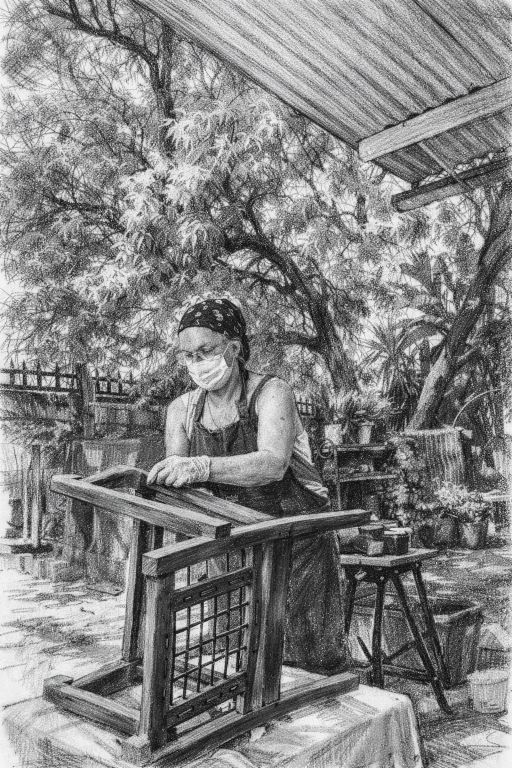
I have recently taken up woodworking—mostly restoring damaged furniture. I spend my weekends taking apart wobbly chairs, learning from other restorers’ mistakes while trying not to make too many of my own.
I didn’t expect this to lead to philosophy. But the workshop is not neutral. It keeps presenting small, stubborn problems where the interaction between your hand and the material forces immediate adjustment. The wood sometimes “talks” to you through its smell, grain, and feel under your fingers.

At the moment, I am working on an Imbuia chair. I’ve followed the standard advice—cleaned it with the recommended chemicals and let it dry. The rest should be straightforward. But the sandpaper keeps clogging.
I hesitate before changing grit. Dropping from 120 to 80 feels like admitting I’ve misread something basic.
Enter Robert M. Pirsig. Zen and the Art of Motorcycle Maintenance—published in 1974—was popular reading when I was a student, although I realise now I didn’t fully understand it then.
I didn’t first solve the problem intellectually; my hands registered that something was wrong. Pirsig calls this Dynamic Quality—the “pre-intellectual cutting edge of reality”: the moment you know something is off before you can explain why.
In woodworking, there is a point where the material presents itself before interpretation—hardness, resistance, texture. Only afterwards do you name and diagnose.

Zen was a bestseller, although not all agree that Pirsig should be placed within the context of mainstream philosophy.
Read, rather than dominate the material
If you’ve worked with wood, you’ll recognise this. One section behaves; another doesn’t. You apply the same method, and it fails—not dramatically, but enough to disrupt your rhythm.
More pressure leaves marks that must be removed. What should take five minutes stretches into half an hour. You fall into what Pirsig calls a gumption trap: persisting with a plan (120 grit, steady pressure) even as the material indicates it is not working.

When I finally switched to 80 grit, the resistance returned. The surface responded. The faint, sweet smell of Imbuia emerged.
Only afterwards do you explain it:
- wrong grit
- harder section of wood
- surface contamination
The shift is subtle: you stop trying to dominate the material and start trying to read it. Woodworking is less about control than about aligning yourself with something already there.
Back to the Things Themselves
As a student of philosophy, Edmund Husserl comes to mind. His idea of the life-world (Lebenswelt) refers to the world of lived experience prior to scientific abstraction. His method of epochē—bracketing assumptions—invites us to encounter things as they present themselves.
In the workshop, this means suspending the “120-grit rule” long enough to see how the tool actually behaves in relation to this piece of wood.
Maurice Merleau-Ponty extends this insight. The body is not merely directed by the mind; knowledge is carried in movement. When a craftsperson is absorbed, perception and action form a single system. My hands register the grain’s resistance before my eyes identify the cause.
A Small Problem for Postmodernism
Postmodernism often claims: we only know reality through interpretation.
Pirsig complicates this: there is a level of engagement that precedes interpretation.
You cannot interpret away a cross-grain scratch. You cannot negotiate with a tenon cut too thin. The grain runs where it runs, regardless of your conceptual framework.
This is the resistance of the real: the fact that reality places constraints on what works. The material does not adjust to your understanding; your understanding must adjust to the material.
The limits of interpretation
There is a moment, prior to theory, where you are in direct contact with the material. This is not yet conceptual. It is where skill begins.
But this immediacy is not sufficient on its own. The material also exceeds perception. It resists.
If you choose the wrong grit, sand against the grain, or apply uneven pressure, the result will show it. Practice exposes constraints before theory accounts for them.
This is where New Realism sharpens the argument. Thinkers like Maurizio Ferraris and Markus Gabriel argue that reality is not exhausted by our descriptions of it. The feedback you receive is not merely interpretive—it arises because the material has an independent structure.
The grain exists whether or not you perceive it correctly, even if your access to it is always mediated by perception and technique.
Taken together, this defines the limits of interpretation:
There is a level of experience that precedes interpretation
There is a level of reality that exceeds it
Interpretation operates between these two. It is necessary—but neither the starting point nor the final authority.

Things to think about
Is interpretation fundamental—or derivative?
Does meaning arise only through interpretation (postmodernism), or is it grounded in something prior, such as lived experience?
- Postmodern view: meaning is constructed through language and context
- Phenomenology (Edmund Husserl / Maurice Merleau-Ponty): experience precedes conceptualisation
- Pirsig: a pre-intellectual encounter guides understanding
👉 Debate:
Can interpretation ever be primary, or must it always rest on pre-conceptual experience?
Does mediation undermine realism?
If all access to reality is mediated (language, perception, culture), does that weaken the claim that reality exists independently?
- Postmodernism: no unmediated access → suspicion of objectivity
- New Realism (Maurizio Ferraris / Markus Gabriel): mediation does not eliminate independence
👉 Debate:
Can we meaningfully claim an “independent reality” if we never encounter it outside mediation?
The epistemological status of “resistance”
Is the “resistance of the real” (e.g. wood grain, physical feedback) sufficient proof of realism?
- Practical argument: failed action reveals constraints
- Counterpoint: even “resistance” is interpreted through frameworks
👉 Debate:
Does material resistance provide epistemic access to reality, or is it still interpretation all the way down?
Support Assistant
Do we see the world as it is—or as we think it is?
- Are we mostly reacting to reality itself?
- Or to our ideas, assumptions, and labels about it?
👉 Everyday angle:
Think of disagreements—are people seeing different realities, or interpreting the same one differently?
Leave a Reply