Archives, Timing, and the Ethics of Disclosure

The archive as an airbrush
A few years ago, I watched “Wat is waarheid” (What is truth) on a South African TV Channel. This series examines popular theories to initiate a discussion on “what is true”. One of the episodes focused on the myths and realities of the Anglo-Boer War, especially the atrocities committed by the British Soldiers, the circumstances of women and children in concentration camps, and the burning of homesteads. Some of the facts regarding these events, were buried in the Havenga files for 80 years, suppressed in a triple bind.
I was surprised by how emotional I felt about that. But these were our grandmothers and great-great-grandmothers, after all. I remember some of my grandmother’s stories, of the British soldiers cruelly killing the farm pigs with their bayonets, for fun. The suppressed accounts of rape and assaults felt very personal to me.
| a truth revealed while it can still have consequences carries a different ethical weight from one disclosed only after those consequences have expired. |
In the opening of his novel, The Book of Laughter and Forgetting, Milan Kundera tells a story about a Czech politician named Clementis. In a famous photograph, Clementis stands next to the leader Gottwald. But a few years after the photo was taken, Clementis fell out of favour and was executed. The state’s propaganda department simply airbrushed him out of history. All that remained of him in the official photo was his fur hat on Gottwald’s head.
Kundera wrote, “The struggle of man against power is the struggle of memory against forgetting.” His insights on memory and forgetting provide a conceptual lens for understanding the suppression of the Havenga Files.
He suggests that forgetting is rarely accidental; it is organised, cultivated and politically useful. Memory, according to him is not lost – it is managed.
The Havenga Files
The collection is associated with Nicolaas Christiaan (“Klasie”) Havenga, who during the war acted as a notary and personal assistant to General J.B.M. Hertzog. At Hertzog’s request, Havenga recorded sworn affidavits from Boer women describing abuses by British soldiers. Herzog wanted to use this as international anti-British propaganda. He wanted to prove that Britain was committing “barbaric deeds” in violation of the Hague Convention. The women’s statements were not necessarily taken down by Havenga himself, but by respected Boer leaders and others such as magistrates H.H. van Coller of Heilbron and S.J. Wessels of Kroonstad. All the statements were recorded in 1901 and 1902.

The collection is larger than these affidavits alone. Archival descriptions indicate that it contains over fifty sworn statements documenting a range of civilian hardships, including mistreatment, looting of farmhouses, and the destruction of homesteads and livestock under British scorched-earth policy (van der Merwe 2014).
When peace negotiations began and the Treaty of Vereeniging was being prepared, Hertzog abandoned efforts to publicise the material, and the documents were set aside. The women’s stories lost their political value. The Boer leadership shelved them to avoid upsetting the new peace.
For decades, the files remained inaccessible. They were not destroyed — but they were also not part of public history. Only in 1982 were they formally opened in the Free State Archives, almost eighty years after the war they described.
Why did that moment of disclosure mattered so little?
What the Archive Omits
The accounts contained in the files were from one area (Free State). This was not an attempt at all to document the assaults and quantify them, but collected mostly for their immediate propganda value.
The affidavits were not collected for the sake of social justice.
Equally important, though, is that there never was an attempt to document the experience of African women, who almost certainly experienced violence during the war. Dr. Mpho Manaka wrote a gendered analysis of why these women’s stories were specifically targeted for erasure from national memory.
Why was the Havenga files suppressed until 1982
The answer lies in a layered architecture of silence.
Firstly the files were set aside by Herzog himself, after the Peac Treaty was signed.
In 1948, the apartheid government under D.F. Malan imposed a 40-year state embargo, citing the political sensitivity of material in the collection (which pushed the embargo to 1988). This posed a double-lock: even when Havenga’s moratorium expired, the state embargo remained, and even if the state wanted to lift the embargo earlier, Havenga’s terms would have blocked access.
Before his death (1957) Havenga placed a 25-year moratorium on his privste papers, starting after he died.

It could be debated whether the Havenga files were in fact, supposed to be part of Havenga’s private collection of papers.
There was never an attempt to contradict this.
International examples show, however, that citizen action could have advocated for earlier lifting of these embargos.
Many questions remain:
- Why was the files seen as too sensitive and needed to be embargoed by the state?
- Why was there no request for lifting the embargoes through citizen intervention?
The Afrikaans poet, writer, and scholar Antjie Krog, who was also involved in the South African Truth and Reconciliation Commission, studied the files and suggests a few compelling reasons as to why the state did not want these files to be made public.
Other scholars have debated whether the Havenga affidavits are representative, credible, or exceptional. These are important questions — but they do not address the deeper issue.
Antjie Krog have asked how these testimonies function as historical documents — who speaks through them, what they make visible, and what kinds of questions they compel us to ask about memory, power, and responsibility. She also provides possible reasons for the suppression of these files.

Beyond the formal embargoes, Antjie Krog points to a wider political and cultural architecture of silence that made the Havenga files easier to forget than to confront.
- The “white male handshake” of post-war reconciliation
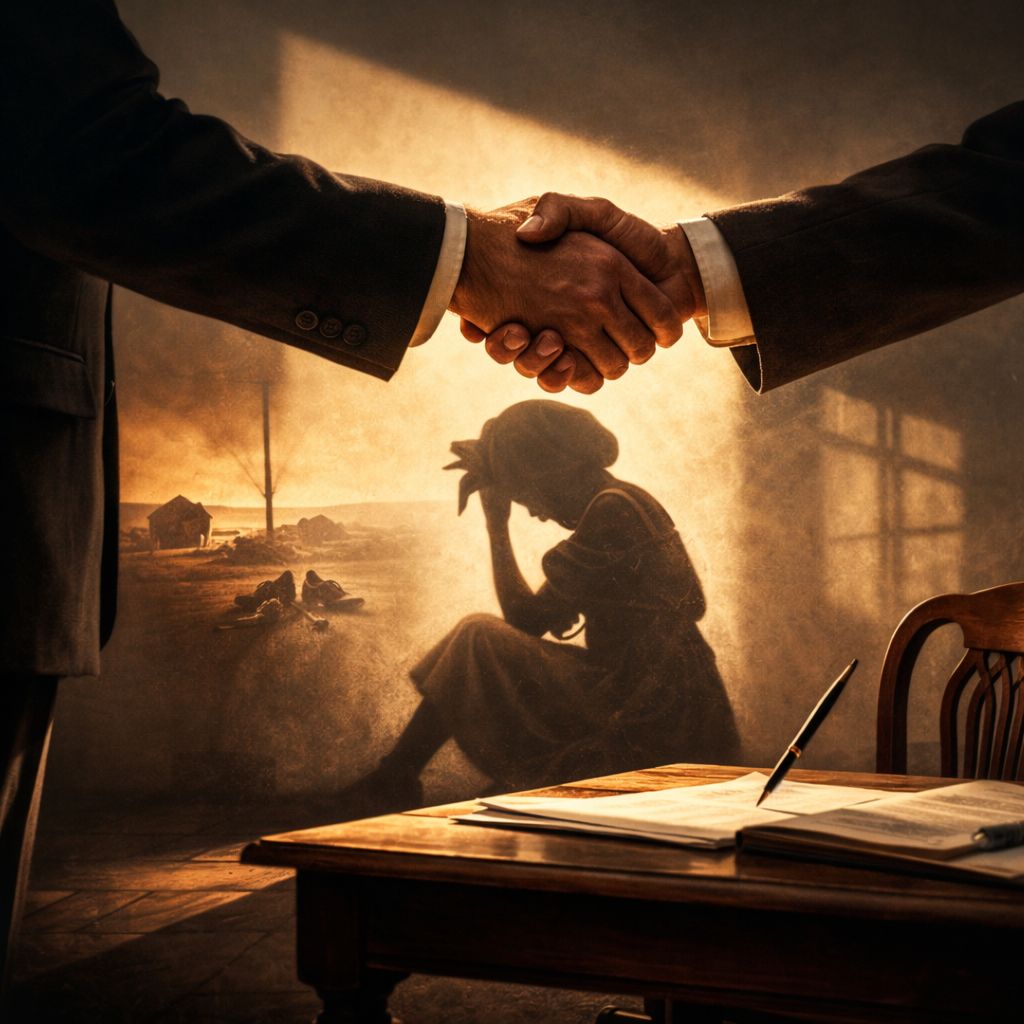
The political settlement that created the Union of South Africa depended on a tacit agreement among white male elites — Boer and British — to prioritise reconciliation over reckoning. Publicising evidence of sexual violence would have disrupted this fragile consensus. - The founding narrative of white unity in South Africa
The files threatened the emergent narrative of white nation-building after 1910. Acknowledging systematic violence against Boer women by British soldiers complicated a story that required shared victimhood and solidarity among white South Africans. - Gendered disbelief and the minimisation of women’s testimony
Women’s accounts of sexual violence were not treated as politically or historically authoritative. Krog suggests that patriarchal norms made such testimonies easier to sideline as “emotional,” “private,” or “embarrassing” rather than matters of public record. - Nationalist selectivity in memory under apartheid
The apartheid state had little incentive to highlight British atrocities that did not neatly serve its own ideological project. The files did not fit comfortably into the dominant nationalist narrative, so they were allowed to remain obscure. - Discomfort with the moral implications of the testimonies
The affidavits implicated not only British soldiers but also broader questions about imperial power, wartime sexual violence, and civilian vulnerability — issues that neither Britain nor South Africa was eager to confront publicly. - The relegation of sexual violence to the private sphere
Krog points out that rape in war has historically been treated as an unfortunate by-product rather than a central political crime. This made it easier to keep the material out of official histories. - Archival culture that privileges administration over testimony
The state archival system tended to treat the affidavits as peripheral, “personal,” or exceptional documents rather than as core historical records requiring active dissemination. - The political convenience of forgetting
More broadly, Krog frames the silence as part of a larger pattern in which difficult truths are not actively suppressed so much as allowed to fade from view because remembering them is inconvenient. - Fear of destabilising contemporary politics (even in 1982)
Although the files were opened when embargoes expired, Krog suggests that neither the apartheid state nor Britain had any interest in amplifying them, as doing so might have complicated existing political positions. - Absence of an organised constituency demanding disclosure
Unlike the Mau Mau case in Britain, there was no powerful legal or activist movement pushing for the files’ release or public reckoning, which made continued quiet easy.

One might also argue that the women’s affidavits, having never been used, represent a betrayal of their willingness to share deeply personal humiliation with men in positions of power.
If the files were opened in 1982, why did their disclosure not reshape how the Anglo-Boer War is remembered? Why did it not transform school curricula, public debate, or understandings of imperial violence?
Why did this truth, once revealed, arrive too late to matter?
Safe truth and ethical theatre
If truth is disclosed only when it no longer threatens power — when perpetrators are dead, liability has expired, and political stakes are low — does remembrance still function as accountability? Or does it become ritual?
Ricœur describes this as the tension between memory, history, and forgetting — where recognition can occur without justice (Ricœur 2004).
Seen this way, the Havenga files are not just a story of hidden atrocities, but a case study in how power manages uncomfortable truths through timing.
An archive can be opened, yet the structures that shape interpretation, education, and public discourse may remain unchanged. Transparency, carefully calibrated, can look like accountability while functioning as ethical theatre — a performance of openness that costs little and changes less.
The Four Moments of Silencing: Trouillot identifies that silences enter the production of history at four crucial stages: the creation of facts (the sources), the creation of archives, the elaboration of narratives, and the final interpretation of history. The Havenga files represent a failure at multiple stages.
We are also reminded that the voices of Black African women were never even registered as “facts” to be archived, creating an “ultimate amnesia” in the historical record

Sinning quietly : international parallels
Britains’s “Operation Legacy”
In the 1950s and 60s, the British Colonial Office systematically destroyed or hid records that could embarass the government. In Kenya, instructions were given to burn files to ash or pack them in weighted crates to be dumped in the sea.
The Dutch “Excessennota”: In 1969
the Dutch government reframed systematic war crimes in Indonesia as incidental “excesses” to maintain a narrative” of white innocence.
The Wiriyamu Massacre
In 1972, Portuguese forces in Mozambique massacred 300 villagers. The event was hidden for a year and later dismissed as propaganda to protect Portugal’s international reputation.
Spain’s “Pact of Forgetting”
Spain offers a different model. After Franco’s dictatorship ended, political elites agreed (informally but effectively) – to a “Pact of Forgetting” (Pacto del Olvido). The aim was stability: to prevent renewed conflict, Spain avoided public reckoning with the crimes of the Franco era. For decades, this pact shaped memory culture. Archives were slow to open; trials were avoided; and public discussion of past atrocities remained limited. Only much later did Spain begin to revisit this history, with partial archival openings. Here, forgetting was not accidental, it was institutionalised in the name of reconciliation. When documents were eventually opened, they often arrived without context, with faded political urgency – producing limited impact.
With political pressure, archives can be opened
In the 2000s, Kenyan survivors of British colonial detention during the Mau Mau rebelliion sued the UK government for abuses, including torture and sexual violence. Their case led to the release of previously concealed colonial records, often referred to as the “Mau Mau files”.
Unlike the Havenga files, these documents were not opened voluntarily. They were disclosed under legal pressure – and their release had tangible consequences. In 2013, the British government issues a formal apology and agreed to a compensation settlement.
Too Late To Matter?

Through Kundera’s lens, the Havenga files appear less as a failure of memory and more as a carefully managed form of it. They were not forgotten – they were safely remembered. This does not trivialise the testimonies. It reframes them as part of a broader politics of memory in which those in power calibrates what is remembered, when, and to what effect.
Is it important?
The group of women whose testimonies were gathered by Havenga for Herzog were white Afrikaans women. In the current South African politics, many people will shrug this off as unimportant. The number? Remember, this was a small sample of women from the Free State, where the alleged events took place, while physical injuries were still evident, implying that there were 100s more women who were assaulted or raped during the 3-year war period.
“The question is not whether societies remember, but which memories are allowed to trouble the present”.
What could justice look like now?
Public acknowledgement
An official recognition by Britain or South Africa that sexual violence occurred during the Anglo-Boer War
Integration of mainstream histories
Incorporating these testimonies into mainstream histories of the war — not as a footnote, but as central to understanding it as gendered and colonial violence.
Curricular reform
Revising school textbooks and public education to reflect the complexity of the conflict, including its impact on women and civilians.
Archival activism
Actively seeking out neglected or marginalised testimonies rather than treating the existing archive as complete or neutral.
Memorialisation
Creating spaces, monuments, or public rituals that recognise the harm suffered, particularly by those whose voices are absent from the archive — including African women.
Material reparations
Historical liability for torture and systematic abuse does not expire. In 2013, the British government paid Pounds 19.9m to Kenyan survivors of colonial era torture, and funded a public memorial.
Redress is not a legal endpoint, but an invitation to continue a dialogue that
restores dignity to the historica ly invisible

Bibliography
Antjie Krog (2015) — ‘They Couldn’t Achieve their Goal with Me’: Telling Rape During the South African War
Krog, Antjie. Binnerym van bloed. Cape Town: Human & Rousseau, 2024.
Kundera, Milan. 1979. The Book of Laughter and Forgetting. Translated by Michael Henry Heim. New York: Harper & Row..
Manaka, Mpho. 2023. “Herstory Lost in Memory: The Amnesia on the Commemoration of Black African Women in the South African War.” The Heritage Portal. (Based on a talk presented to the Archaeological Society, Johannesburg, 1 June 2023).
Ricœur, Paul. 2004. Memory, History, Forgetting. Translated by Kathleen Blamey and David Pellauer. Chicago: University of Chicago Press..
Trouillot, Michel-Rolph. 1995. Silencing the Past: Power and the Production of History. Boston: Beacon Press.
van der Merwe, Jan J. P. 2014. “Die ‘Havenga-verslag’ oor verkragtings en die mites daaromheen.” LitNet.
Use of Wikipedia for information about historic parallels.
Things to think about
The Paradox of “Ethical Theatre”: Does the TRC’s focus on “narrative truth” substitute for justice? If a transitional justice mechanism like the TRC prioritises public truth-telling and building empathy through testimony while failing to deliver material reparations or pursue criminal prosecutions for those who were denied amnesty, does the process function as “ethical theatre”—a performance of openness that costs the state little and changes less?
The Ethics of Timing: When does truth lose its capacity to act in the present?
Selective Victimhood and “Ultimate Amnesia”: Whose suffering is deemed worthy of the archive? Archives are not neutral containers but political instruments that regulate visibility. This raises the question: why are some traumas, like those of white Boer women, preserved as “ethical disturbances” while the experiences of Black African women remain a vacuum of “ultimate amnesia” in the official record?
Strategic Remembering vs. Organized Forgetting: Can memory be used to protect power?
The Right to “Sin Quietly”: Does state stability justify the erasure of the memory of atrocities?
Leave a Reply